
Property Taxes Too High? How to Sell Your House in Shelton, CT and Keep More of Your Equity
Your house is paid off. The property tax bill never will be.
Maybe you opened your last tax bill and read it twice. Maybe you've started covering it out of savings that were supposed to last another ten years. Either way, the math has changed: the house is paid for, but the bill that comes with it keeps growing, and your income doesn't.
Property taxes too high for the life you're living now? Social Security, a pension, a retirement account you're trying not to drain — none of it was built to keep up with a bill like this. It doesn't mean you handled money badly. It means you own a home in a state with the third-highest effective property-tax rate in the country, according to a Tax Foundation analysis of Census data. You're equity-rich and cash-poor, and that's a real problem with real solutions.
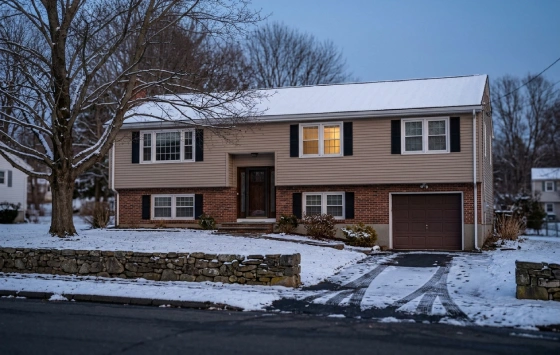
This guide is for Connecticut homeowners — especially in Shelton and the towns around it — who are trying to decide what to do next. It explains how your bill is actually built, why revaluation years hit so hard, which relief programs to check first, and what selling would really leave in your pocket. If selling turns out to be the right move, it also shows what a cash sale with Helpful Home Buyers looks like from your side of the table. That's Dan and Meghan, right here in Shelton.
Get a fast, no obligation cash offer!
Fill out this form to get started on your fair all-cash offer.
Get Your Fair Cash Offer
Fill In This Form To Get Your No-Obligation All Cash Offer Started!
"*" indicates required fields
Property Taxes Too High? Start With How Your Bill Is Built
Every Connecticut property tax bill comes from the same simple formula. Once you see it, the jumps start to make sense.
- Your assessment. Connecticut towns assess real estate at 70% of its fair market value as of the town's last revaluation. A house the town values at $400,000 carries a $280,000 assessment.
- Your town's mill rate. A mill is $1 of tax for every $1,000 of assessed value. Your town sets its mill rate each year when it adopts its budget.
- Your bill. Assessment × mill rate ÷ 1,000. At 30 mills, that $280,000 assessment owes $8,400 a year — about $700 a month, before insurance, heat or a single repair.
Mill rates vary a lot from town to town. In fiscal 2025–26 they ranged from about 10.85 to 68.95 mills across Connecticut, according to the state's published mill-rate data. That's why two similar houses a few miles apart can carry very different bills.
Why revaluation years hit so hard
Connecticut law requires every town to revalue all of its real estate every five years (CGS § 12-62). Shelton did it as of October 1, 2025, and those new values drive tax bills from July 2026 through June 2031. When home values rise across town, your assessment rises with them. The town may lower its mill rate to make up for it — but if your home's value rose faster than the town average, your bill can still go up.
That's why a revaluation can feel so personal: nothing about your house changed, but its share of the town's budget did. Just got a new assessment notice? Our step-by-step guide on how to appeal a property tax assessment in Connecticut covers the February 20 deadline, the evidence that helps and what happens at the hearing.
Check Every Relief Option Before You Decide
Selling isn't the only answer, and for some homeowners it isn't the best one. Before you decide anything, make sure you're not leaving help on the table.
- Appeal if the value is wrong. Does your assessment count square footage you don't have, or a finished basement that isn't finished? File a written appeal with your town's Board of Assessment Appeals by February 20. Some towns extend that to March 20 in a revaluation year.
- The state Circuit Breaker credit. Homeowners 65 or older, or totally disabled, with incomes under the state limits can get a credit of up to $1,000 (single) or $1,250 (married). For applications filed in 2026, the limits were $46,300 single and $56,500 married, and they change every year. You apply through your town assessor between February 1 and May 15.
- Local freezes and deferrals. State law lets towns offer their own senior relief, including freezes and deferrals (CGS § 12-129n and §§ 12-170v and 12-170w). Some programs set asset limits or place a lien on the home for the relief you receive, so ask how it gets repaid.
Our side-by-side guide to Connecticut property tax relief for seniors shows who qualifies, what each option is really worth, and how to weigh relief against a sale. If a credit or a successful appeal closes the gap, staying may be the right call — and that's a perfectly good outcome.
CT Homeowners Love Us!
Here’s how HHB helped people move forward—quickly, quietly, and on their own terms.

Sharon Kiraly
Fairfield, CT
..he made a very fair and equitable offer to purchase my home of 30 years and was sensitive to all my cherished memories of living there, raising my family, and then parting, making it a bearable transition.
I’m very grateful to Daniel Riccio.
Louis - Macdonald
Road Trumbull, CT
The entire process ran smooth and the company was extremely accommodating to our family's needs. They were understanding and gave us the opportunity to have extra time after the sale to sort through our belongings. Whatever we no longer wanted they kindly let us keep on the property and they took care of it for us.
I would highly recommend working with them!
Karen Mavilia
Howe Ave Shelton, CT
Second time with Dan Riccio and and his all-star team -- a rental property in 2019, now my home in January 2025. Flawless synchronicity from start to finish. Downright upright ethics -- so rare today. All commitments met and expectations exceeded. 24/7 project management, impressive array of skilled contractors resolved all issues in a timely professional manner. Best of all, I simply took what I wanted and left all remaining contents.
When Selling Makes More Sense Than Holding On
For many retired homeowners, the problem isn't a lack of wealth. It's where the wealth is sitting. If your house is paid off, most of what you own is locked inside the walls — and the only thing it sends you each month is a bill.
Try this quick check. Take your yearly tax bill, add homeowners insurance, heat and a realistic amount for upkeep, and multiply by five. For example, $8,400 a year in taxes alone is $42,000 over five years — before the roof, the furnace or the next revaluation. Now compare that with what your equity could do if it were working for you instead. It could buy a smaller home with a smaller bill, a condo with no driveway to shovel, or a move closer to family.
That's the point where many owners start looking at ways to downsize your home in Connecticut on their own terms. If you've been circling the idea, here's why the new year is a smart time to downsize — a short, practical read for anyone planning a change this year.
And if your plan is a bigger move — to be near the grandkids or out of the snow — read our guide to moving from Connecticut to Florida. It lays out the right order of steps: sell first or buy first, how to close from out of state, and which taxes follow you.
What You Actually Keep When You Sell a Connecticut House
Before you decide, it helps to know what comes out of a sale. Three items matter most.
- The conveyance tax. Connecticut charges a real estate conveyance tax when a home sells (CGS § 12-494). The state portion is 0.75% on the first $800,000 of a residential sale, with higher rates above that. Towns add 0.25%, and certain targeted investment communities can add up to 0.25% more. On a $450,000 sale, that's about $3,375 to the state and $1,125 to the town. The seller's side files the return and payment with the town clerk, so build it into your numbers. The Department of Revenue Services' summary of the conveyance tax tiers shows the current rates.
- Federal tax on your gain. The federal home-sale exclusion lets you exclude up to $250,000 of gain, or $500,000 for married couples filing jointly. You generally qualify if you owned and lived in the house as your main home for two of the last five years. If you bought decades ago, run the numbers with a CPA — especially if you're single or recently widowed.
- Repairs, commissions and time. A traditional listing usually means repairs, showings, an agent's commission and months of carrying costs while you wait. A cash sale skips all of that, in exchange for a price that reflects the house as it stands.
Every situation is different, so talk to your CPA or attorney before you sign anything. What you want is a clear, written number you can set next to all of the above.
What a Cash Sale With Helpful Home Buyers Actually Looks Like
Helpful Home Buyers is a Shelton company run by Dan and Meghan, who have spent more than 15 years investing in Connecticut real estate and have bought more than 50 houses. Here's how a sale works — five steps, no commissions, no showings.
- Step 1 — You reach out. Fill out the form below or call. We'll ask a few questions about the house, your timing and where you're headed next. You can also read how our Connecticut cash sale works before you call.
- Step 2 — One walkthrough. We walk through the house once, at a time that suits you. No cleaning, no staging, no repairs — and no strangers touring your home on weekends.
- Step 3 — A written cash offer within 24 hours. You get a written, no-obligation offer within 24 hours of the walkthrough. Put it next to your tax bill, your relief options and your CPA's numbers, and take the time you need.
- Step 4 — You pick the closing date. Close in as little as about 10 days, or later if you need time to line up a smaller home, a lease or a move south.
- Step 5 — Proceeds at closing. No commissions and no fees come out of your sale. Ask how closing costs and the conveyance tax are handled in your written offer, so you know exactly what you'll walk away with.
You don't have to take our word for it. Read what Connecticut homeowners say about working with us — the company has a 4.6-star average rating on Google and a BBB profile.
Frequently Asked Questions
Read More About Your Specific Situation
Most homeowners weighing a tax bill against a sale are in one of these situations. Pick the guide that fits where you are.
→ Connecticut revaluation: why your assessment jumped and how to appeal — the February 20 deadline, the 70% rule and what a mill rate really tells you.
→ Moving from Connecticut to Florida or the Carolinas — sell first or buy first, closing from out of state, and the taxes that follow you.
→ Connecticut property tax relief for seniors vs. selling — Circuit Breaker limits, local freezes and deferrals, and when a sale is the better answer.
→ Selling your home as a Connecticut senior — our earlier guide to planning a move after retirement, at your own pace.
Helpful Home Buyers buys houses from homeowners facing rising property taxes throughout Shelton, Hartford, West Hartford, Orange, Newington and communities across Connecticut.
Get a Written Number to Put Next to Your Tax Bill
You don't have to decide anything today. Get the number first: a written, no-obligation cash offer you can compare against five more years of taxes, insurance and upkeep. Request your cash offer, and Helpful Home Buyers will set up one walkthrough at a time that works for you. If the numbers say stay, you've lost nothing. If they say go, you'll go on your schedule, with your equity in hand.